How to Choose the Right Press Tonnage for Press-Fitting and Assembly
A press that is too small stalls; one that is too big wastes money and accuracy. Use these steps to estimate the press tonnage your part really needs.
In this article
Getting the press tonnage right is the first step in buying any press. If the press is too small, it stalls or wears out early. If it is far too big, you pay for capacity you never use — and on a servo press you may lose some force-measuring resolution at the low end.
What decides the force for press-fitting
For press-fitting a bearing, pin, bush or shaft, the force mainly depends on:
- Interference: how much bigger the shaft is than the hole. More interference means more force.
- Contact length and diameter: a longer or larger fit needs more force.
- Materials and surface finish: steel in steel needs more force than steel in aluminium; rough surfaces and no lubrication increase friction.
- Wall thickness of the outer part: a thick housing resists expansion and raises the force.
Estimating press tonnage step by step
- Use real data first. If you already press this part by hand or on another machine, measure the force with a load cell. Real data beats any formula.
- Calculate if there is no data. Engineers use the interference-fit (Lamé) equations to estimate contact pressure and then the pressing force. Your design engineer or our team can do this from the drawing.
- Add a safety margin. Select a press whose rated capacity is about 20–30% above the highest force you expect, so tolerance variation never stalls the press.
- Check the frame and daylight. Make sure the stroke, open height (daylight) and table size fit your part and tooling.
Servo or hydraulic for this tonnage?
Up to about 100 ton, an electric servo press is often the best choice for press-fitting because it can stop at an exact position and record a force–displacement curve for every part. Above that, or for forming and drawing work, a hydraulic press is usually more economical.
Do not forget safety and tooling
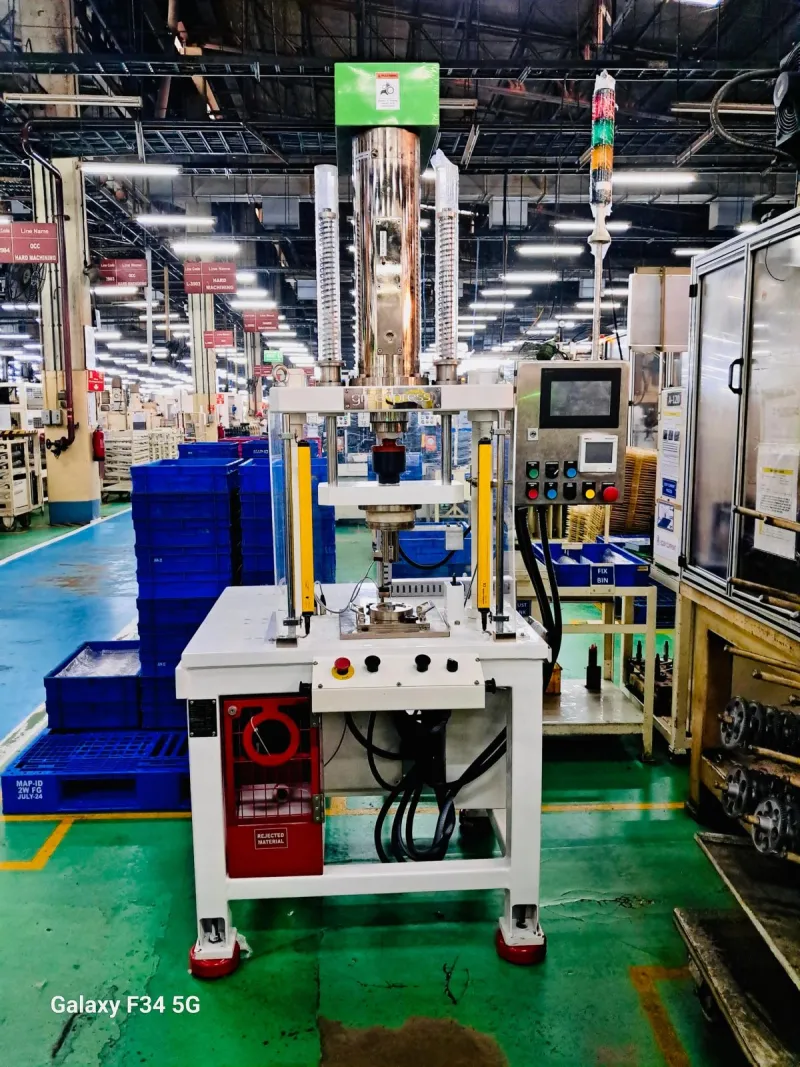
A correctly sized press still needs the right tooling and guarding. Two-hand controls, light curtains and part-present sensors protect operators and stop wrong parts from being pressed. GreenPress® machines are supplied tooled for your part with these safety options.
Get a free tonnage check
Send us the part drawing, materials and expected production volume through the enquiry page. Our engineers will recommend the press tonnage, frame type and options — usually within one business day.